ATU SYSTEMS · GUIDE
Aerobic Treatment Units (ATU) in Florida: How They Work and When They're Required
An Aerobic Treatment Unit (ATU) is an onsite wastewater treatment system that uses oxygen-rich (aerobic) bacterial digestion to break down sewage, producing significantly cleaner effluent than a traditional anaerobic septic tank. ATUs are required in Florida wherever site conditions disqualify a conventional drain field. Typically because of high water table, shallow soils, or proximity to environmentally sensitive water bodies. And in specific county-mandated zones. They are more expensive to install and require mandatory ongoing maintenance contracts, but they make onsite treatment possible on lots where it would otherwise be denied.
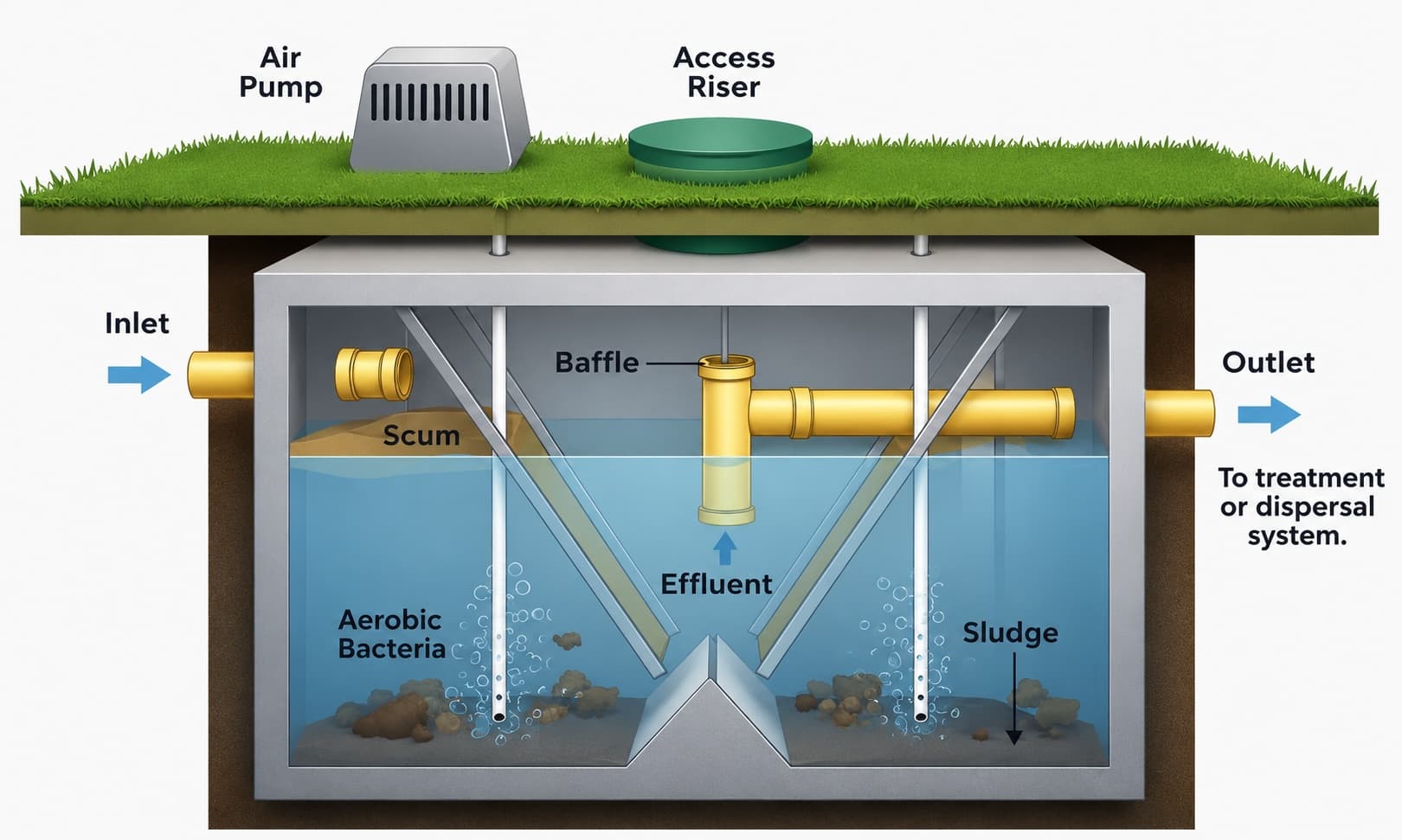
How an ATU works
An ATU typically consists of three sequential chambers:
- Trash trap (or pretreatment chamber). Receives raw sewage and removes large solids and grease, similar to the front section of a standard septic tank.
- Aeration chamber. The defining feature of an ATU. A blower or compressor introduces continuous air, supporting an aerobic bacterial community that consumes organic waste much faster and more thoroughly than anaerobic bacteria in a traditional tank. The high dissolved oxygen content produces a much cleaner effluent.
- Clarifier. A settling chamber where any remaining solids drop out, with cleaner water at the top discharged to dispersal. Some designs return settled solids back to the aeration chamber for further treatment.
The effluent leaving the clarifier is dramatically cleaner than what leaves a conventional septic tank. Typically with biochemical oxygen demand (BOD) reduced by an order of magnitude and suspended solids reduced similarly. That clean effluent can be dispersed in smaller fields, drip systems, or sometimes above-ground spray systems where regulations permit.
ATU vs traditional septic tank
| ATU (Aerobic) | Conventional Septic | |
|---|---|---|
| Treatment type | Oxygen + aerobic bacteria | No oxygen, anaerobic bacteria |
| Effluent quality | High (clean enough for smaller field) | Lower (relies on soil for finishing) |
| Drain field size | Smaller field possible | Larger field required |
| Power required | Continuous (blower) | None |
| Maintenance | Mandatory contract (quarterly inspections, FAC 64E-6) | Pumping every 3-5 years; no required contract |
| Install cost | Higher | Lower |
| Operating cost | Power + contract | Just periodic pumping |
| When required | High water table, shallow soils, sensitive zones | Standard conditions, sufficient soil depth |
NSF/ANSI 40 and 245 standards
ATUs sold in the United States are certified to NSF/ANSI performance standards. Two standards apply to most residential systems:
NSF/ANSI 40 is the baseline standard for residential onsite wastewater treatment systems. It requires the system to consistently produce effluent meeting defined limits on biochemical oxygen demand (BOD), total suspended solids (TSS), and pH. Class I (Cbod5 less than 25 mg/L, TSS less than 30 mg/L) is the more rigorous tier; Class II is somewhat looser.
NSF/ANSI 245 adds nitrogen reduction performance requirements. Nitrogen-reducing ATUs are mandatory in some Florida counties and coastal zones where excess nitrogen contributes to algal blooms and water quality issues. Including portions of SWFL near the Gulf of Mexico, Charlotte Harbor, and the Indian River Lagoon system.
The mandatory maintenance contract
Unlike conventional septic, Florida requires every ATU to operate under an active maintenance contract with a licensed septic system inspector. Quarterly visits at minimum, with each visit producing a county-filed report. A required visit includes:
- Blower or compressor inspection. Running, audible, drawing correct amperage
- Aeration chamber check. Dissolved oxygen measurement, mixed liquor observation
- Clarifier and dispersal pump test. Verifying function
- Alarm testing. Confirming activation
- Effluent quality observation. Clarity and odor
- Sludge depth measurement in pretreatment chamber
- Written report filed with the county health department
Lapsing the maintenance contract is a serious compliance issue. The county can revoke the operating permit; in extreme cases, the property cannot legally discharge sewage to the system until compliance is restored.
QUESTIONS HOMEOWNERS ASK
ATU FAQ
Next steps
If your home has an existing ATU and you cannot confirm the maintenance contract is current, that is the first thing to address. A licensed inspector can review your system, file the next required report, and put you on a quarterly schedule. If you are planning a new build or replacement on a lot where conventional septic may not be approvable, get a soil evaluation and ATU design consultation before committing to a system type.
RELATED GUIDES
- Septic Tank Installation for New Florida Builds
Choosing tank size and material for a new build, the design-permit-install sequence under FAC Chapter 64E-6, soil and water table evaluation, and how to coordinate with your GC to avoid expensive sequencing mistakes.
- Drain Field Installation for New Florida Construction
Site evaluation, perc testing, soil profile requirements, system sizing per FAC 64E-6, engineering oversight, and the construction sequence that keeps a new drain field on schedule with the rest of the build.